

In the past, I had to give an oral presentation on the SIG PRO 2022 pistol. I chose not to start the presentation directly with this firearm, but rather to cover it in a second part after introducing its predecessors. The goal was to highlight the master plan of technical advances in the French service pistol, of which the adoption of the SIG PRO 2022 is a part. At the time of writing this article, it equips the National Gendarmerie, the National Police, and Customs.
Across two articles, I am offering you an expanded transcript of this presentation.
This first article will briefly detail each of the four models leading up to the SIG PRO 2022 pistol. We will uncover a lineage connecting some of them, and we will explore the principle of heritage in product design.
In a second article, we will look at the developments introduced by the SIG PRO pistol, the qualities its replacement should possess, the replacement protocol, and then draw our conclusions. You can find this second article by following this link : The Successor to the SIG PRO 2022 Pistol.
The MAC 35A Pistol
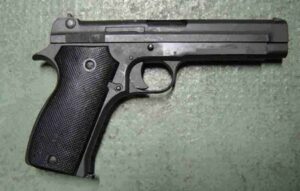
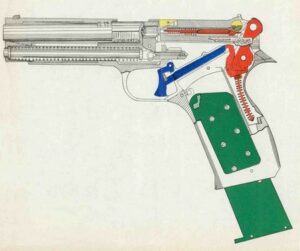
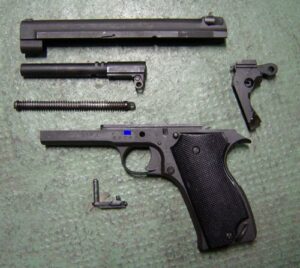
The MAC 35A pistol is one of the first French-made service pistols adopted by France. I am excluding the Star, the Ruby, and other handguns purchased during World War I, as they were more the result of stopgap purchases driven by necessity.
Testing campaigns in the early 1920s (1921/1922) led to the adoption of this firearm in 1935. It took roughly 18 years between the start of the program and the first delivery.
For this firearm, a cartridge of the same caliber as the French pistols of the Great War (7.65 mm) but of higher power was selected. Because of this increased power, a locked-breech system was required.
A voir également : The MAC 35 A pistol.
Specifications of the MAC 35A :
-
- Caliber: 7.65 mm Long ;
- Overall length: 195 mm ;
- Barrel length: 110 mm (4 right-hand grooves, 250 mm twist rate) ;
- Height: 126 mm ;
- Unloaded weight: 670 g ;
- Magazine capacity: 8 rounds ;
- Action: single action, removable fire control unit (FCU), locked breech, short recoil;
- Production: approximately 85,000 units between 1937 and 1950 (approx. 6,540 per year) ;
- Muzzle velocity: 330 to 345 m/s ;
- Muzzle energy: 30 to 36 kgm (approx. 294 to 353 J).
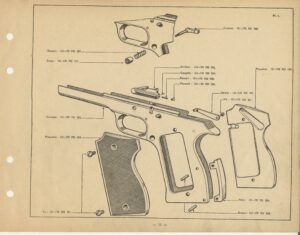
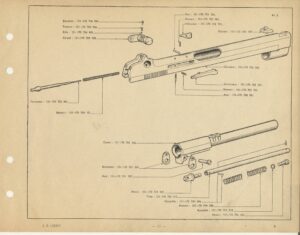
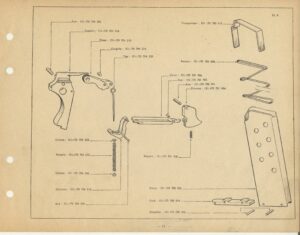
The testing period and adoption of this pistol were lengthy, yet they introduced several advances. What are these notable improvements compared to previous French military pistols (Ruby, Star, etc.)? The 35A introduced a number of features that would carry forward into future designs.
The advantages of the MAC 35A :
-
- A push-button magazine release ;
- An exposed hammer ;
- A removable fire control pack, allowing easy cleaning by the operator ;
- A lightweight, slim, and sleek firearm ;
- A new caliber slightly more powerful than the 7.65 Browning (.32 ACP) ;
- More consistent manufacturing quality ;
- High-grade steels ;
- Interchangeable magazines ;
- Lightweight and comfortable to carry ;
- A locked breech, featuring two swinging links beneath the barrel ;
- A safety lever blocking the firing pin ;
- A removable front sight ;
- A loaded chamber indicator ;
- A magazine disconnect safety ;
- A rear sight machined directly into the slide.
Conclusion on the 35A :
This pistol laid the foundations of an aesthetic and technical heritage that would reappear in the next two models. This resemblance would become even more striking (because it was more direct) in a lineage produced by the manufacturer SIG, giving rise to the Swiss Army service pistol and the magnificent P210-6 model.
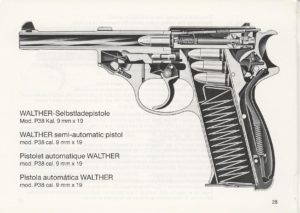
During the same period, Germany adopted the P38, a 9 mm double-action pistol, while Browning introduced its Hi-Power (GP 35), a high-capacity 9 mm single-action pistol.
The MAC 35S Pistol
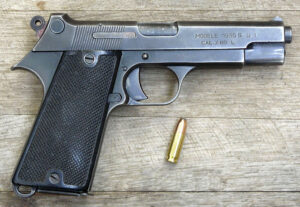
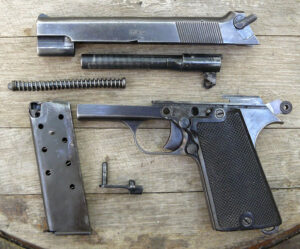
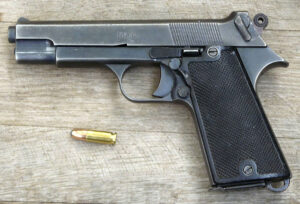
Photos sourced from: armoury-online.ru
The MAC 35S pistol supplemented the rollout of the firearm discussed previously. An initial batch of 1,400 pistols was delivered in 1940.
Specifications of the MAC 35S :
-
- Caliber : 7.65 mm Long ;
- Overall length : 188 mm ;
- Barrel length : 106 mm (4 right-hand grooves, 254 mm twist rate) ;
- Overall height : 121 mm ;
- Unloaded weight : 720 g without magazine, 828 g with loaded magazine;
- Magazine capacity : 8 rounds ;
- Action: single action, removable fire control unit, locked breech, short recoil, Colt-Browning system ;
- Production: approximately 82,753 units between May 11, 1939, and 1951 (approx. 6,365 per year) ;
- Muzzle velocity : 330 to 345 m/s ;
- Muzzle energy : 30 to 36 kgm (approx. 294 to 353 J).
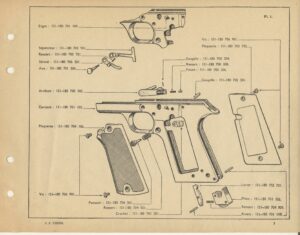
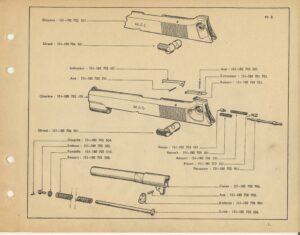
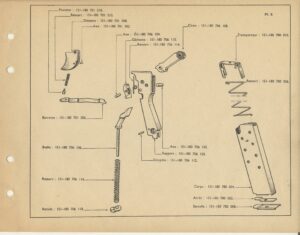
Notable improvements over the MAC 35A :
-
- A firearm simpler to manufacture ;
- A single barrel locking link instead of two ;
- Both front and rear sights machined directly into the slide.
Conclusion on the MAC 35S :
Its aesthetic heritage with its successor is stronger than with its predecessor, though an influence is still perceptible.
With this pistol, simplicity and ruggedness were gained while weight was reduced. The firearm remained slim compared to other handguns of the era, which is natural given its small-diameter cartridge.
The MAC 50 Pistol
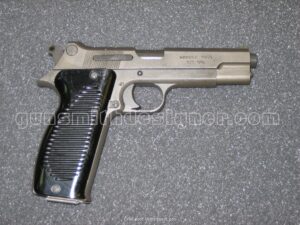
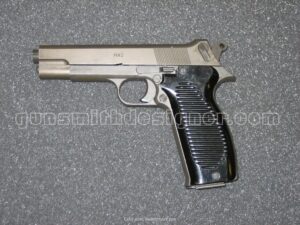
This program dates back to 1946. Manufacturing began on February 27, 1951, and the first 100 units were delivered in June 1953—roughly 7 years between program launch and initial delivery.
A single glance is enough to recognize the heritage linking the MAC 50 pistol to its predecessors. Although the caliber changed, the internal architecture remained very similar.
It gradually replaced an assortment of disparate handguns, thereby standardizing the military inventory.
By choosing to manufacture the firearm in a state-owned arsenal, France demonstrated a desire for independence both in future supply chains and in manufacturing quality.
Specifications of the MAC 50 :
-
- Caliber: 9 mm (9×19mm) ;
- Overall length: 200 mm ;
- Height: 140 mm ;
- Thickness: 30 mm ;
- Barrel length: 112 mm (4 left-hand grooves) ;
- Unloaded weight: 950 g without magazine, 1,094 g with loaded magazine;
- Magazine capacity: 9 rounds ;
- Action: single action, removable fire control unit, locked breech, short recoil ;
- Production: approximately 341,900 units between May 11, 1953, and 1978 (approx. 13,676 per year) ;
- Muzzle velocity: 340 to 360 m/s ;
- Muzzle energy: 48 to 59 kgm (approx. 470 to 578 J).
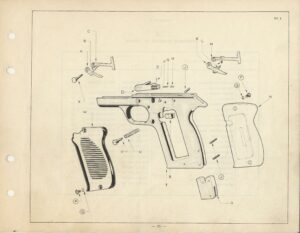
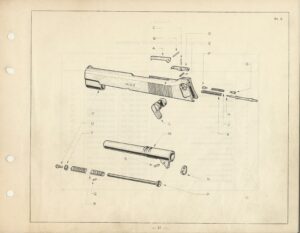
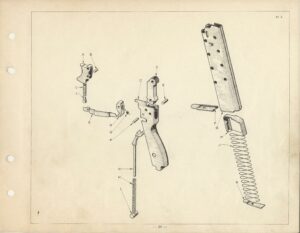
Notable improvements over the MAC 35A and 35S :
-
- Caliber change, transitioning to 9 mm ;
- Only the frame bears the serial number ;
- Delivered in a transparent plastic box.
Conclusion on the MAC 50 :
Various links clearly connect the first three models, likely stemming from a shared culture or influence among the designers. The removable fire control pack, single-action mechanism, similar aesthetics, and use of the Colt-style locking system are all part of these shared traits.
The list of evolutions is not long, as there is no fundamental shift between the MAC 35A and the MAC 50.
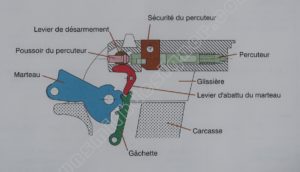
The MAC 50 was criticized for the placement of its safety lever. Indeed, it was not uncommon to inadvertently engage the safety while racking the slide—a serious drawback for a service weapon. Such incidents must also have occurred with the two earlier pistols, since their safety levers were located in the exact same spot, yet no major redesign was ever undertaken to relocate it.
Still no high-capacity magazine or double-action trigger, even though 15 years earlier the GP 35 and the P38 had already paved the way.
The MAS G1 and G1S Pistols
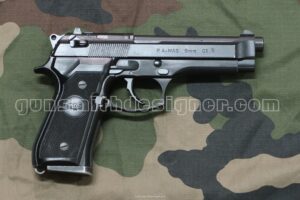
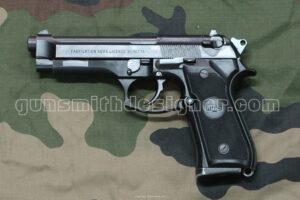
The Beretta 92F was one of the first handguns to combine an aluminum alloy frame, a double-action/single-action (DA/SA) trigger mechanism, high magazine capacity, sleek lines, and a reasonable weight. It was designed by a reputable, well-established manufacturer that excelled in marketing and product visibility.
On July 2, 1987, the MAS G1 pistol (a clone of the 92F equipped not with a manual safety, but with a hammer decocking lever) was adopted. It competed against another icon of the era: the SIG SAUER P226. Since the Beretta design was less expensive, it was selected.
This firearm represented a first break with tradition—albeit a partial one. For the first time in a long while, the pistol’s design was not French. However, its manufacturing was: GIAT was tasked with producing and assembling the firearm. It was likely thanks to bringing in an “outside” design that France benefited from the latest advances in handgun technology. The MAB P15 might have replaced the MAC 50 had decision-makers stayed within a strictly domestic mindset.
Design heritage exists for this pistol as well. To see it, one need only look at Beretta’s history: several Beretta pistols closely or distantly resemble the Model 1934.
Specifications of the MAS G1 and G1S :
-
- Caliber: 9×19mm ;
- Overall length: 217 mm ;
- Height: 137 mm ;
- Thickness: 38 mm ;
- Barrel length: 125 mm (6 right-hand grooves, 250 mm twist rate) ;
- Unloaded weight: 960 g with empty magazine, 1,260 g with loaded magazine;
- Magazine capacity: 15 rounds ;
- Action: double and single action (DA/SA), locked breech with P38-style falling locking block, short recoil ;
- Production: approximately 110,000 pistols over 7 to 8 years, or roughly 13,750 firearms per year.
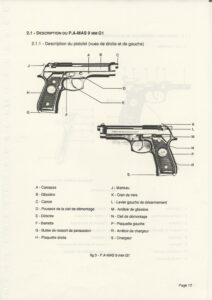
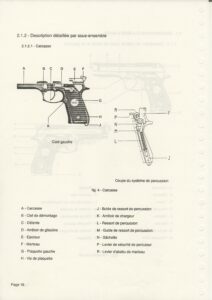
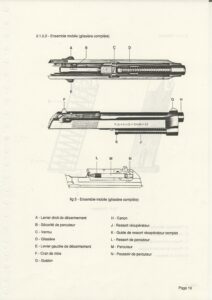
Notable improvements over the MAC 50 :
-
- High-capacity 15-round magazine ;
- Dovetailed rear sight, adjustable for windage and potentially for elevation by replacement ;
- Firing pin block safety ;
- Squared trigger guard ;
- Hammer decocking lever ;
- Aluminum alloy frame (easier to machine) ;
- Barrel, frame, and slide all serially numbered ;
- Chrome-lined bore ;
- Non-removable fire control mechanism (integrated into the frame) ;
- Locking system similar to that of the Walther P38 pistol ;
- Two-piece barrel assembly (barrel and locking block) ;
- Double-action and single-action trigger mechanism ;
- Supplied with a storage loader/spacer and a magazine loader ;
- Reversible/ambidextrous magazine release.
Conclusion on the MAS G1 and G1S :
It is amusing to note that by adopting the MAS G1/G1S pistol, France broke away from French design continuity (MAC 35, MAC 50) to adopt an Italian heritage and lineage. Indeed, the MAS G1/G1S is derived from the Beretta 92, which itself echoes the lines of early Beretta pistols, notably the Model 1934.
The adoption of the MAS G1/G1S was a major leap forward. This progress came from the commercial firearms industry, which successfully combined the brand’s aesthetic heritage with :
-
- A locking mechanism borrowed from the P38 ;
- The high-capacity magazine concept (pioneered by the GP 35) ;
- A modern, lightweight material (aluminum) ;
- An innovative design ;
- Modern marketing.
A French pistol could have been in the running: the MAB P15. Beretta would later adopt the MAB P15’s rotating-barrel locking principle for another Beretta model (though that is another story).
Starting in 1989, the first MAS G1 pistols were assembled using Beretta components, and subsequently with GIAT-made parts. Following issues with slide cracks and failures, the pistols were recalled to the factory for user safety. The modification consisted of replacing the hammer pin with an enlarged head, machining a groove in the slide, and machining the left grip panel. During this upgrade program, MAC 50 pistols were temporarily reissued. Once modified, the MAS G1 was redesignated as the MAS G1S. This demonstrates the importance of keeping manufacturing close at hand, or maintaining domestic infrastructure and trained personnel ready to intervene. What if it had been a Chinese or Turkish firearm ?
Conclusion
Conclusion to this first article :
This article has highlighted the concept of aesthetic and technical heritage. While this trait is celebrated in prestigious modern brands, we have no reason to be embarrassed or surprised to find it in the MAC 35 and MAC 50 pistols. The break in heritage among the firearms mentioned above was due to the adoption of a foreign pistol born from a different lineage.
Past and future articles on French service firearms neither show nor will show any flaw in manufacturing execution (as French firearms are very well built). Rather, the shortcomings lie elsewhere: in the choice of mechanisms and calibers, delays in adoption and production, an intellectual sluggishness perhaps rooted in a state-arsenal engineering culture, and a resistance to change.
It would have been interesting to attempt an evolution of the MAC 50. That could have yielded a pistol with an aluminum frame and a high-capacity magazine (much like Para-Ordnance did for the Colt .45). Adding a firing pin safety and double-action capability would have been more complex without redesigning the slide as well.
We bought from others what we could have developed ourselves. Of course, hindsight is always 20/20 once the battle is over. In this respect, we echo once again the Gunsmith Designer articles on the Chassepot rifle or the Model 1892 revolver, and the difficulty of being a visionary—or better yet, having a team of visionaries and granting them the resources to bring their vision to life. Providing skilled engineers with firearms from all over the world to broaden their knowledge and synthesize existing mechanisms is vital in a design office. The MAS G1/G1S is itself a synthesis.
The MAC 50 pistol was the last handgun designed and manufactured in France. Opening up to the MAS G1/G1S brought valuable external design insights—we became the carriers of someone else’s vision.
How does the successor to the MAS G1/G1S compare to its predecessors ? We will explore that soon in the second part of this article.