

This article is the logical continuation of the article titled: The Master Plan of Technical Advances in the French Service Pistol.
Knowing that you must understand where you come from to know where you are going, we will start by examining the firearm to be replaced and seeing where it stands relative to its predecessors. Next, we will attempt to look ahead and list the features that the next French service pistol could possess. Finally, we will discuss the replacement protocol.
The SIG PRO 2022 Pistol
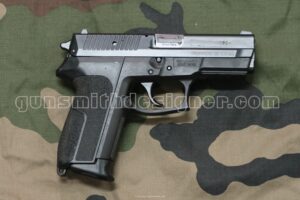
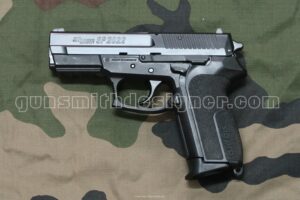
With the adoption of the SIG PRO 2022 pistol, the master plan of technical advances in the French service pistol took a small leap forward. Here are its strengths :
-
- A sturdy carrying case bearing the firearm’s serial number ;
- An electronic microchip embedded in the frame ;
- A Picatinny accessory rail ;
- An empty chamber flag (chamber safety indicator) ;
- A polymer frame ;
- A removable fire control unit (with the aid of tools) ;
- A squared trigger guard ;
- A hammer decocking lever ;
- A firing pin block safety ;
- A heavy-duty extractor ;
- A one-piece barrel ;
- A removable grip module providing access to the mechanism ;
- Removable front and rear sights ;
- A reversible/ambidextrous magazine release ;
- An anti-corrosion finish on the slide.
Operating Principles of Its Successor
There is little chance that we will reinvent the wheel when replacing the SIG PRO 2022 pistol.
Based on this premise and the previous article, what types of mechanisms might equip the next French service pistol? In my view, two types of firing mechanisms and two types of locking systems are likely. What are they?
Firing mechanisms :
-
- Hammer-fired (exposed or internal) in single and/or double action (e.g., MAS G1/G1S, SIG PRO 2022, and others) ;
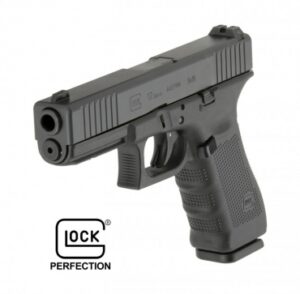
- Striker-fired / “axial” percussion (e.g., Manufrance Le Français, Glock, and others).
Locking systems :
-
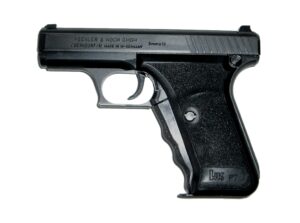
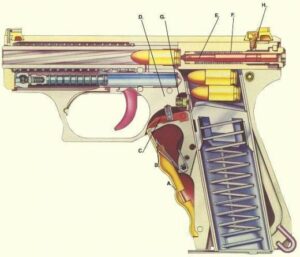
- Fixed barrel and gas-delayed blowback (e.g., HK P7 type) ;
- Linkless Colt-Browning tilting-barrel locking system (e.g., SIG PRO 2022).
This gives us 4 possible combinations :
-
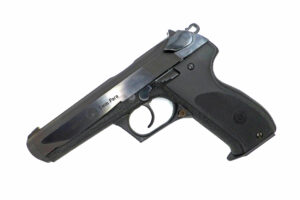
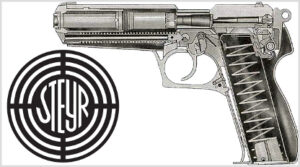
- Hammer-fired and fixed barrel (e.g., Steyr GB 80) ;
-
- Hammer-fired and linkless Colt-Browning cam-locking system (e.g., CZ 75) ;


-
- Striker-fired and fixed barrel (e.g., HK P7) ;
-
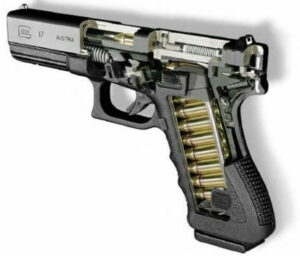
- Striker-fired and linkless Colt-Browning cam-locking system (e.g., Glock).
Specifications for Its Successor
It will now be difficult to erase certain developments and operational habits from collective memory. It is hard to imagine taking a step backward by adopting a service pistol with an 8-round capacity, no firing pin safety, and a single-action-only trigger. Ideally, what specifications should we demand and expect from the new handgun?
Key assets of a service pistol :
-
- A simple and rugged firearm ;
- Chambered in 9 mm or larger ;
- A minimal number of parts ;
- A minimal number of springs ;
- Safe carry with a round chambered ;
- Compact footprint (suitable for both uniformed patrol and plainclothes/investigative units) ;
- Use of durable, high-resistance materials ;
- A low bore axis ;
- Easy user field-stripping ;
- Ability for the user to clean the fire control unit ;
- High-capacity magazines ;
- …
The slide :
-
- Removable steel sights ;
- Sights available in various sizes, but non-adjustable ;
- No manual safety lever ;
- A firing pin safety ;
- Proper heat treatment in the locking area (if a locking system is used) ;
- Deep slide serrations (for pulling the slide back) ;
- Both rear and front slide serrations ;
- An effective anti-corrosion coating ;
- A chamfered/truncated lower rear slide profile (to protect the guide rails) ;
- A heavy-duty extractor that doubles as a loaded chamber indicator ;
- A push-button extractor plunger/pin (no roll pin) ;
- A firing pin or striker assembly not retained by a roll pin ;
- A gas relief vent hole to reduce recoil ;
- Easy disassembly of the firing pin/striker and extractor (with minimal tools) ;
- …
The frame:
-
- A polymer frame, dyed throughout, resistant to solvents ;
- Long, machined slide guide rails ;
- A modular grip available in various sizes ;
- A squared trigger guard ;
- A Picatinny or similar rail under the frame ;
- A generously sized, ambidextrous steel magazine release ;
- A removable grip easily taken off by the operator ;
- A sturdy attachment point for a lanyard ;
- A magazine capacity of 17 or 18 rounds (either to increase ammunition loadout per officer or to reduce spring fatigue with a 15-round loadout) ;
- No pins installed using a press or retained with O-rings (unlike the SIG PRO 2022) ;
- Houses a steel chassis/insert supporting the firing or trigger mechanism ;
- A metal cradle/locking block for the barrel ;
- An embedded tracking microchip ;
- …
The barrel :
-
- Must be a one-piece construction ;
- Its length determines the compactness of the firearm ;
- An integral feed ramp machined into the barrel ;
- Either a linkless Colt-Browning tilting-barrel locking system using angled locking lugs/cam (like Glock, SIG PRO 2022, CZ 75) ;
- Or a fixed barrel secured to the polymer frame via a metal cradle that also incorporates the guide rails ;
- Gas relief vent ports to reduce recoil ;
- …
The firing mechanism :
Hammer-fired :
-
- A hammer-fired mechanism (such as the MAS G1/G1S, SIG PRO 2022, and derivatives) housed in a removable fire control pack easily disassembled by the operator and supported by the polymer frame ;
- This fire control chassis is retained in the polymer frame by a pin ;
- No sear notch wear, requiring a hammer and sear made of properly hardened steel ;
- Pins that stay securely in place without the grip panel installed ;
- A relatively heavy trigger pull to prevent negligent discharges ;
- A fire control pack accessible to the operator ;
- …
Striker-fired (“axial” percussion) :
-
- A firing mechanism housed inside the slide (such as Glock and derivatives) ;
- Pins that stay securely in place ;
- A relatively heavy trigger pull to prevent negligent discharges ;
- A firearm allowing immediate firing without manually cocking the striker ;
- A fire control pack accessible to the operator ;
- …
The trigger mechanism :
-
- A trigger and a trigger bar/disconnector ;
- A wide trigger shoe ;
- A crisp, positive trigger return spring ;
- An integrated trigger safety lever (optional) ;
- A short reach from the backstrap to the trigger (for smaller hands) ;
- …
Accessories :
-
- A storage loader/spacer ;
- A sturdy empty chamber indicator flag ;
- A rugged carrying case (hinges and latches) with a combination lock ;
- A one-piece cleaning rod threaded for brushes and a patch jag ;
- Bronze/brass, nylon, and felt bore brushes/mops ;
- A magazine speed loader ;
- 2 or 3 magazines, or higher-capacity magazines ;
- Magazines protected against corrosion and harsh conditions, easy to maintain (polymer body or polymer-coated) ;
- An optical sight mounted on top of the firearm for specialized units ;
- An attachment point for hooking a lanyard ;
- …
Maintenance :
-
- A set of GO / NO-GO headspace gauges for the chamber and bore ;
- A firing pin protrusion gauge ;
- An extractor tension/clearance gauge ;
- A recoil spring tester ;
- Use of minimal tooling ;
- If possible, no expensive, heavy, and rarely used proprietary tools ;
- A complete armorer’s manual ;
- An exploded-view parts manual organized by sub-assemblies ;
- Specialized training for armorers ;
- …
Procedures :
-
- An online electronic firing logbook to track the number of rounds fired, visible at the central level to trigger scheduled maintenance and spare parts shipments to armories ;
- Comprehensive user training ;
- …
The Adoption Process
Drafting the technical specifications :
It was with a touch of idealism that we looked at the potential operating principles and specifications of the new firearm. These can be nuanced and combined.
First, choices among the various specifications will be dictated by selecting either a hammer-fired or a striker-fired (“axial”) system. Second, the breech-locking principle can represent another trade-off. I chose to highlight two locking systems that, in my opinion, are the most likely and most reliable for a service handgun. It should be noted that a fixed barrel allows for a very low bore axis, resulting in a more compact firearm. Once these two choices are made, the technical specifications are virtually defined.
Our initial idealism will soon hit the wall of reality :
-
- Will the models submitted by manufacturers live up to our ideal ?
- The more participants there are, the wider the selection—how many manufacturers will respond to the tender ?
- One can imagine that a sought-after manufacturer, distributing a reliable firearm that meets the specifications, might choose not to compete for various reasons (unwillingness to restructure its industrial tooling, production volume too large, etc.) ;
- Will all European manufacturers be motivated to participate in this contract ?
- Which manufacturer can supply roughly 250,000 pistols, and over what timeframe ?
- …
The testing and validation protocol is an adventure in itself :
-
- How do you define tests that accurately reflect the hardships the firearm will endure during its time in service ?
- How many rounds should be fired during testing ?
- Which cartridge model should be adopted for testing ?
- What accuracy test, and at what distance ?
- How many handling, assembly, and disassembly cycles ?
- What cleaning intervals should be applied during testing ?
- How do you prevent legal appeals from unselected bidders ?
- On what criteria should a firearm be rejected ?
- Which panel of users should be selected ?
- Which panel of armorers and specialists should be selected ?
- Over how many weeks, and at which facility ?
- Where will the participants be housed ?
- Where will they be fed ?
- …
One adventure ends, but another begins: acceptance, distribution, training, and technical oversight :
-
- Defining the acceptance and validation protocol for initial deliveries—by what criteria are batches accepted or rejected ?
- Scheduling deliveries to logistics hubs and subsequent routing down to end-users ;
- Prioritizing initial deliveries to training academies to quickly train new personnel with no prior experience ;
- Technical monitoring of the first deliveries, particularly in training schools where pistols see the heaviest firing ;
- Certifying civil servants through the basic qualification certificate ;
- Delivering initial toolkits and training unit armorers ;
- Being prepared to address large-scale technical issues ;
- Establishing spare parts inventories ;
- …
When the replacement of the SIG PRO 2022 pistol is officially announced, a working group will need to be formed. This will require significant commitment and buy-in from everyone: National Police, National Gendarmerie, and other agencies.
Conclusion
The SIG PRO 2022 pistol is now a few decades old. The original manufacturer no longer produces all spare parts for this firearm. Aftermarket manufacturers have stepped in to supply certain components (springs, magazines, rear sights, front sights, etc.). In the short term, a major spare parts contract was relaunched to keep the pistol in service.
When will the SIG PRO 2022 pistol be replaced? The decision will likely come down largely to the sinews of war: state finances.
In a troubled social and security climate, this is not the time to adopt an unreliable or ill-suited firearm.
Retaining domestic know-how and an operational industrial base on national soil would avoid finding ourselves dependent on one of the few European suppliers capable of delivering hundreds of thousands of firearms. However, maintaining such an asset comes at a cost.
As one can imagine, these choices will carry heavy consequences. The future handgun will probably not be ideal, but any imperfections must be reduced to a minimum.
Over 100 years, the master plan of technical advances in the French service pistol has not been linear. Evolutions have occurred in leaps and bounds across the adoption of these five firearms. What will the future hold? What advances lie ahead? Which pistol will replace the SIG PRO 2022? Toward what aesthetic and technical heritage will we turn?
To compare technical data across comparable countries, one would need to trace and study the master plans of each of those nations. This could yield, for example, the average service life per model by country, when each nation adopted the 9×19mm cartridge, when each country adopted its first semi-automatic pistol, and so on.
In closing, I invite the reader to remember all or part of this article and await the next adoption of a semi-automatic pistol in France—allowing them to continue the analysis begun here and draw their own lessons if need be.