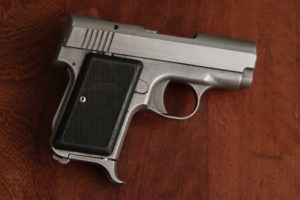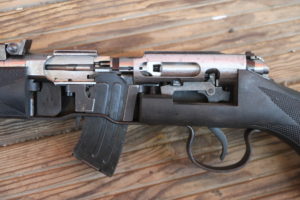


In this new article, we will look at a poorly documented firearm : the Lepage Model 1924 in 7.65mm Browning (.32 ACP).
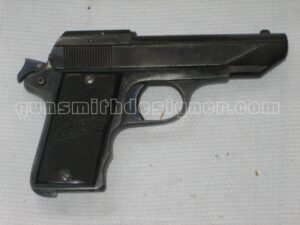
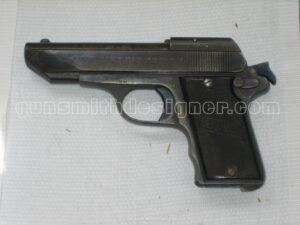
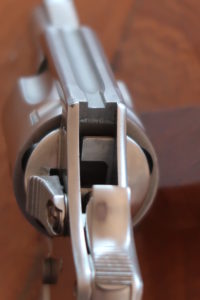
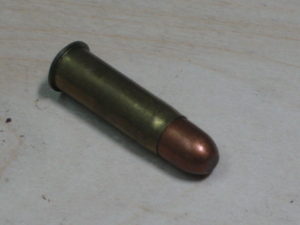
In the past, I had the opportunity to examine a pistol of this model in person. Since I no longer have the firearm in my possession, I cannot provide any more information than the measurements and notes recorded at the time. I am sharing the photos I took back then.
In addition to providing uncommon views, this article will help complete the thread woven by the previous two articles:
It will also allow us to observe another approach to simplification through division applied to handguns. In the article on the AMT Backup II pistol, we saw that simplification was applied to the slide. On the Lepage Model 1924, it is applied to the frame.
The Lepage 1924 Pistol
In an article from La Gazette des Armes issue #196 (January 1990), one can read: “Lepage pistols are of excellent quality, but their excessively high cost prevented them from finding sufficient market outlets, which explains why these firearms are so rare.”
Specifications given in the article :
- Overall length: 146 mm;
- Barrel length: 80 mm;
- Weight: 665 g;
- Capacity: 8 rounds;
- Origin: Belgian (Bayard 1923);
- Designer: Bernard Meyer.
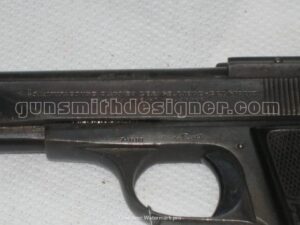
I am surprised to read this, because the firearm before us presents no particular manufacturing difficulty—quite the opposite. I do not see where any extra production costs could be hidden (perhaps higher labor costs than in certain neighboring countries?). In the conclusion, we will see what seems to me to be the real reason for its limited distribution.
Actual measurements of the photographed firearm :
- Weight without magazine: 613 g ;
- Barrel length: 96.5 mm.
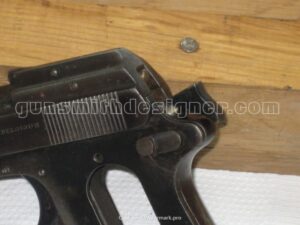
The slide is guided at the front by the barrel and the frame, and at the rear by two lugs carried by the trigger housing assembly (lockwork plate) rather than by the frame itself.
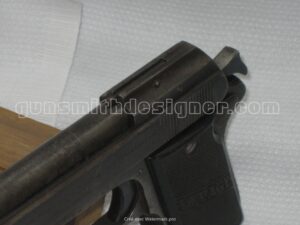
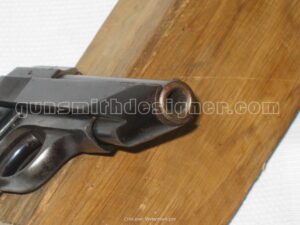
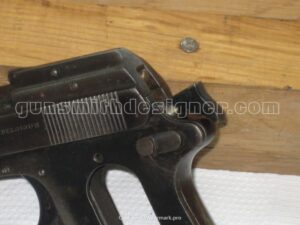
Field Stripping (User Disassembly)
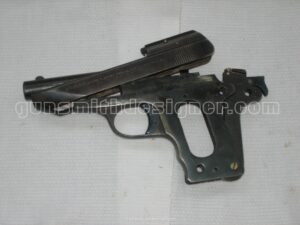
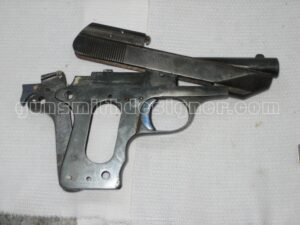
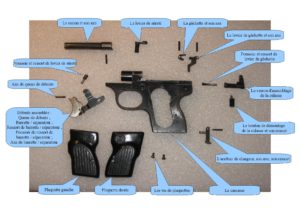
Through the attached photos, we can see that disassembly is fairly straightforward.
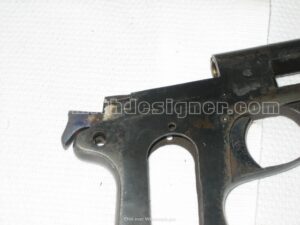
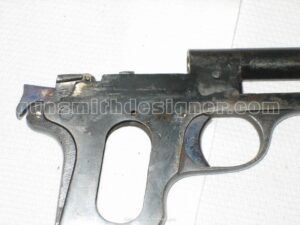
After disengaging the takedown key (latch) that secures the frame to the removable lockwork plate, the latter pivots around a pin located at the bottom of the pistol grip. The slide is then no longer guided and is removed upward.
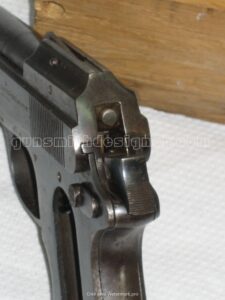
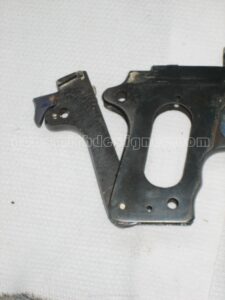
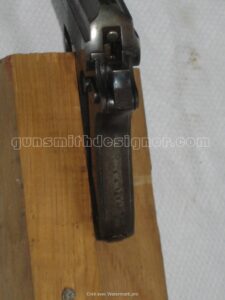
The Frame
The frame fits within a bounding box measuring: 124 mm x 96 mm x 14.8 mm.
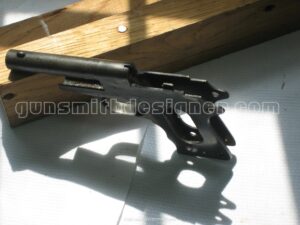
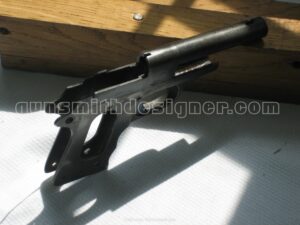
This is the assembly that interests us most, as it benefits from simplification through division. Having a removable lockwork plate makes it possible, depending on the chosen design, to simplify the machining of the magazine well. This machining is usually a complex operation that can require specialized tooling (such as broaching). However, by using two separate parts—as is the case on this firearm—an opening is created at the rear of the pistol grip, allowing the use of a standard milling cutter. A removable lockwork plate also makes it much easier for the user to properly clean and maintain the firearm.
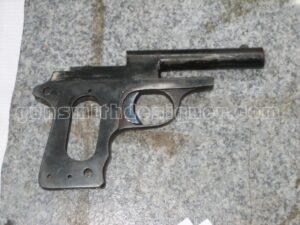
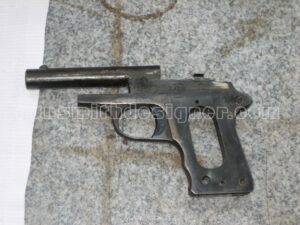
The ejector is an integral part of the frame: a section of the left side wall is bent inward to form the ejector.
The thickness of the frame side walls is 2.1 mm on one side and 1.8 mm on the other. There is therefore a slight offset of the magazine well relative to the centerline of the frame.
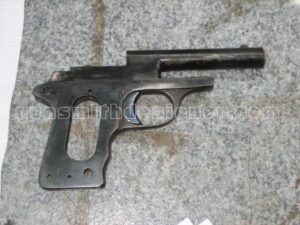
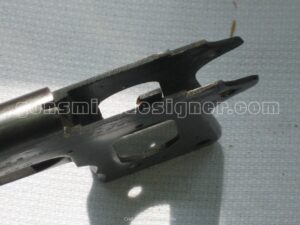
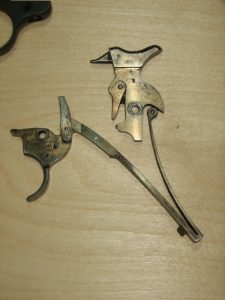
There is no trigger bar or disconnector connecting the trigger to the sear, as is found on many semi-automatic pistols. The firearm shown here is incomplete; it was lent to me without a magazine. However, it appears that the magazine itself transmits the movement of the trigger to the sear. Indeed, when pulling the trigger, the shooter pushes the magazine rearward, which in turn presses against the sear and ultimately releases the hammer.
There is nevertheless a disconnector function, which is actuated by a recess machined into the underside of the slide.
The trigger is blued.
The Removable Lockwork Plate
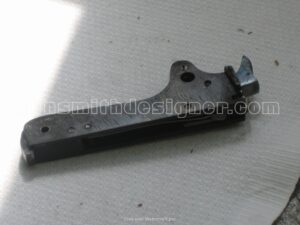
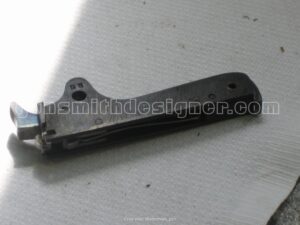
As we saw in a previous article on the French service revolver Model 1892, the latter can be almost completely disassembled quickly by the user. With the Star, Ruby, and other pistols—even more prestigious ones—such ease of mechanism maintenance by the operator was merely a dream. Here, it becomes possible again with the Lepage 1924, without risking improper reassembly. The lockwork plate consists of a single housing unit containing very few parts and is easily detached from the frame, as seen above.
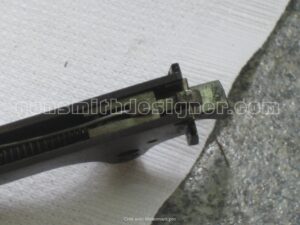
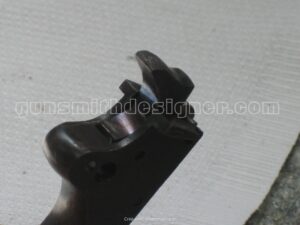
Is the Lepage 1924 pistol the forerunner of the removable trigger/lockwork module? I do not know. However, this principle would later be adopted in different yet similar forms on French military handguns (MAC 35A, MAC 35S, MAC 50).
The width of the lockwork plate is 11.2 mm, which is also the width of the magazine well.
The screws securing the lockwork plate components have a straw-colored (heat-tinted) finish.
The Slide
The slide fits within a bounding box measuring: 144.5 mm x 22.25 mm x ? (height not recorded at the time). The weight of the slide is 193 grams.
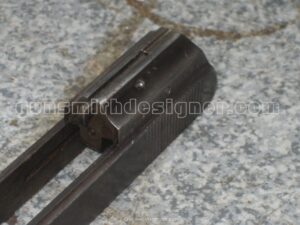
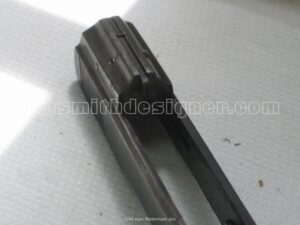
The extractor slot is located on top of the slide.
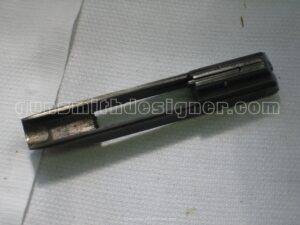
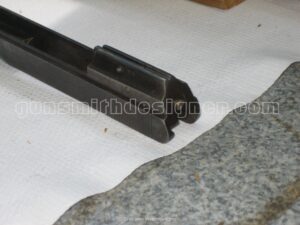
The slide is made of steel. It is very simple and massive, machined from a single piece—no simplification through division here.
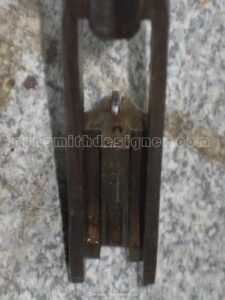
The breech face is completely flat (flush). The cartridge must seat entirely inside the barrel chamber. This detail is significant because, knowing that some semi-automatic pistol frames are shared between their 7.65mm (.32 ACP) and 9mm Short (.380 ACP) versions, knowing that the Lepage barrel can be quickly removed, and knowing that the barrel diameter is compatible with both calibers and very easy to manufacture (being a simple cylindrical part), one realizes that only a barrel swap is required to change calibers—and at a very low cost.
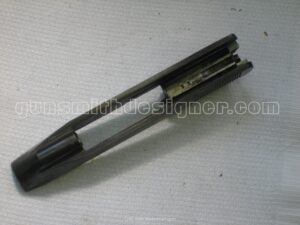
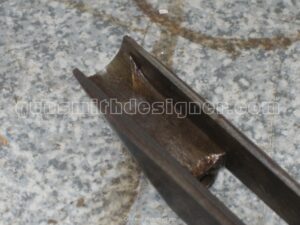
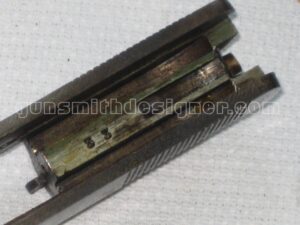
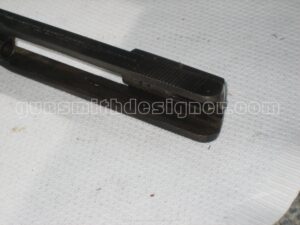
There is no firing pin safety; very few firearms from this era featured one.
Since the breech face is flat, the extractor must protrude forward from the breech face. It needs to be long enough to reach and hook onto the extractor groove of the cartridge case, which sits fully inside the chamber.
The Barrel
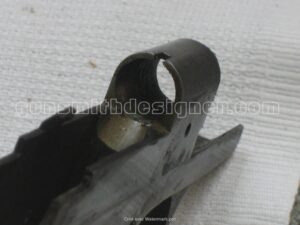
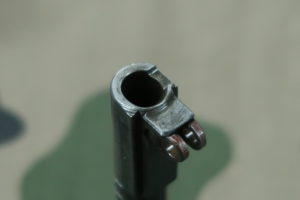
The barrel is a simple threaded cylindrical bar to which a front sight has been added. Its outer diameter is 15 mm.
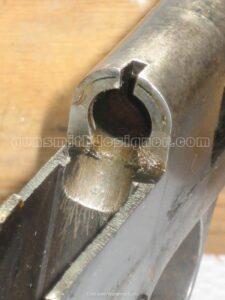
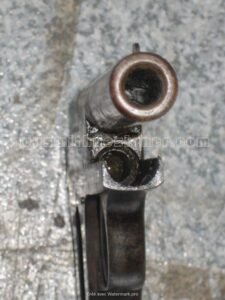
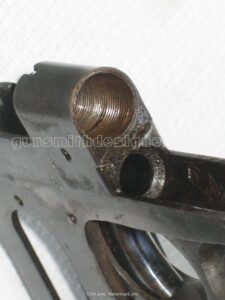
The barrel is secured in its housing by threads as well as a cross pin. The pin was easily driven out, and the barrel removed just as easily (without specialized tools, simply by clamping it in a vise with aluminum V-blocks and turning the frame by hand).
The extractor notch is located along the top centerline of the barrel.
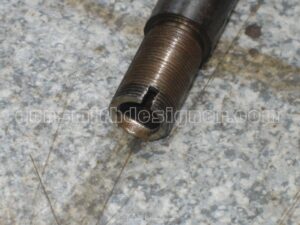
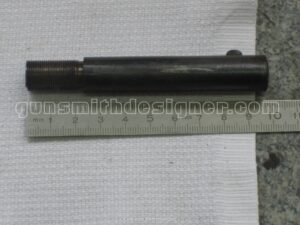
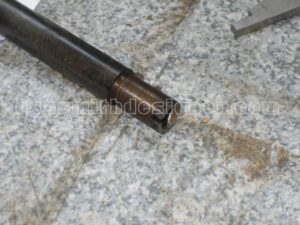
The barrel is threaded to an imperial pitch of 30 threads per inch (0.846 mm). The threaded section is 23.2 mm long, with a major thread diameter of 12.7 mm (1/2 inch), which is also consistent with an imperial thread standard.
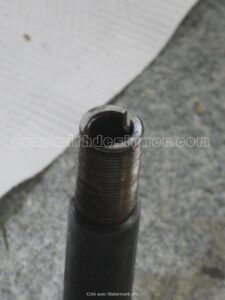
Given that the case body diameter of a 7.65mm Browning cartridge is 8.5 mm, the barrel wall thickness at the chamber is approximately 2.1 mm.
Conclusion
If, by publishing these photos, I have been able to provide rare views and help enthusiasts expand their knowledge, I am delighted—that is the very purpose of this website.
It is likely that this pistol arrived on the market a bit too late, several decades after the Browning 1900 or 1910. It offered nothing truly new while being bulkier and heavier.
The design choice of transmitting trigger pull to the sear via the magazine body is unusual. It can introduce functional issues and prove less reliable, which may have contributed to the pistol’s limited commercial success.
According to the magazine article cited above, the Lepage 1924 pistol supposedly failed to gain popularity due to its manufacturing cost. This is surprising, as it is a very simple firearm compared to its competitors.
Some pistols use an identical frame for both their 7.65mm Browning and 9mm Short (.380 ACP) versions. It would have been interesting to compare this model with the .380 ACP version—or even to machine a .380 ACP barrel to run compatibility tests (strictly within legal bounds, of course!).
The designer of this firearm, reportedly Mr. Bernard Meyer, applied simplification through division to the frame. Our previous article on the AMT Backup II highlighted this same principle applied to the slide. This raises two interesting questions:
-
- Has any designer ever combined both simplifications (frame and slide) on a single firearm?
- Does a firearm exist that pushes the principle of simplification through division to its absolute extreme?
We are temporarily closing the thread woven through these recent articles, which has allowed us to explore the concept thoroughly for now. The next article will focus on a different subject, though we will return to this theme when the time is right and new material is available. I will then attempt to answer these two questions and further sharpen your engineering perspective.