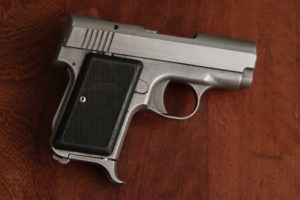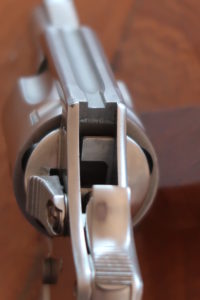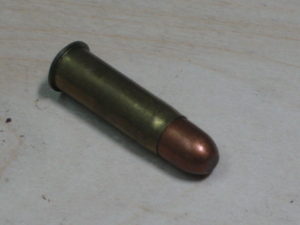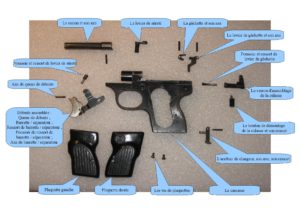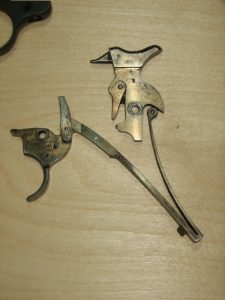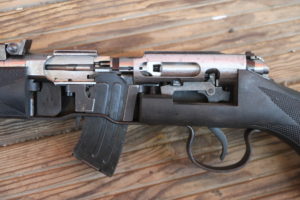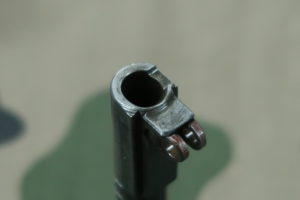


In the previous article, we examined a defensive revolver made using investment casting. In this new article, we will look at a defensive handgun: the AMT Backup II pistol. It is manufactured largely using the same process. These two firearms are equivalent in several respects: same capacity, similar power, but each possesses its own distinct identity, resulting in specific advantages and disadvantages.
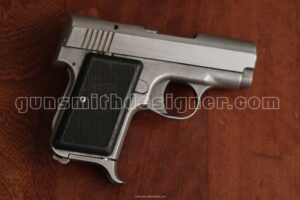
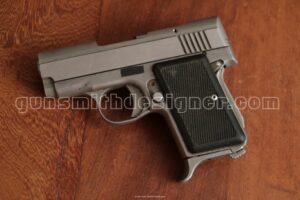
Once again, the driving force behind this article is the desire to highlight the designers’ choices and compare them with those of the Charter Arms revolver.
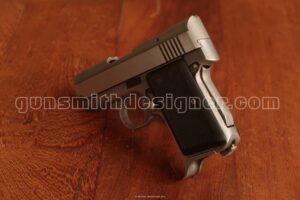
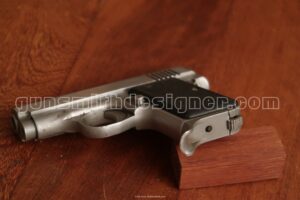
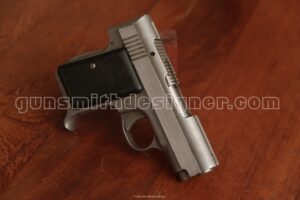
The firearm shown in the pictures is in its original, untouched condition (“dans son jus”). It has been briefly cleaned, but nothing more. This will be the subject of further discussion in the conclusion.
Firearm Presentation
The Backup II is a small defensive pistol produced from 1993 to 1998 by the manufacturer AMT. The company was founded in 1977. Arcadia Machine and Tool (AMT) was a firearms manufacturer based in Irwindale, California. Firearms production by AMT appears to span from 1982 to 1995. Since that date, the company has been acquired several times, eventually landing with High Standard (at least at the time of writing). Looking at the latter company’s website, one cannot say that AMT products are heavily represented.
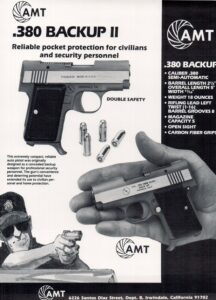
You can find more details here regarding the models originally offered by AMT. The company built its firearms around rapid part-forming processes—specifically, investment casting. It is impressive to see that a high percentage of the total parts are made from blanks obtained through this process.
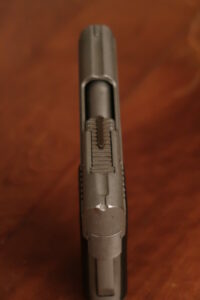
Firearm Specifications :
-
- Caliber: .380 Auto, 9mm Browning Short, 9x17mm ;
- Overall Length: 149 mm ;
- Overall Height (with magazine): 94 mm ;
- Overall Height (without magazine): 101 mm ;
- Width: 23.5 mm ;
- Weight (with empty magazine): 462 grams ;
- Weight (with magazine loaded with 5 rounds): 507 grams ;
- Magazine Capacity: 5 rounds ;
- Materials: Stainless steel, plastic, aluminum.
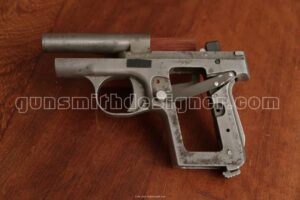
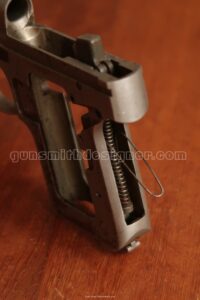
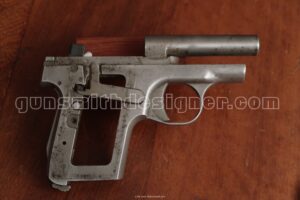
This pistol is a straight blowback firearm; in other words, it is an unlocked breech system. The pressure is not high enough to require locking the slide to the barrel before the bullet leaves the muzzle and the pressure drops. The inertia of the slide, the force of the recoil spring, and the cocking of the hammer are among the forces that delay the opening of the slide. The mechanism is simpler, and the parts are less complicated to build and assemble. This type of action cannot be used with all calibers.
According to CIP standards for the 9mm Short caliber (.9x17mm, .380 Auto):
-
- Average maximum pressure: 1,500 bar
- Average proof pressure: 1,950 bar
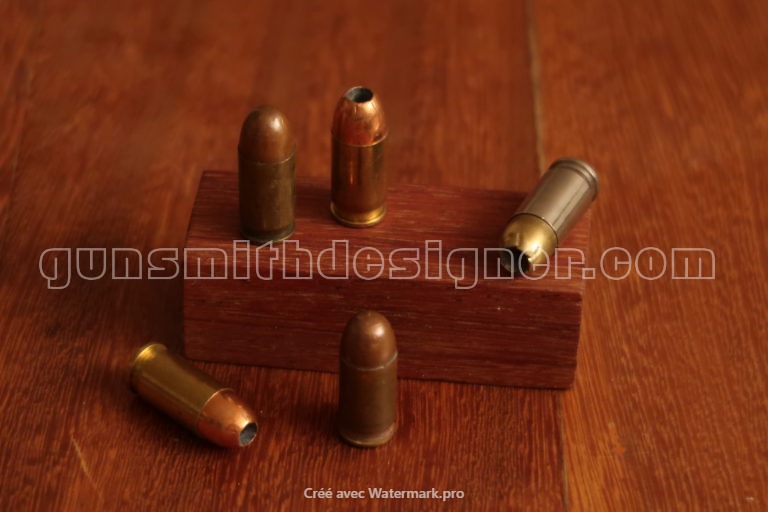
The .380 Auto is an excellent caliber. Due to its low operating pressures (resulting, as seen above, in simple, blowback firearms), the bullet’s velocity is subsonic. Consequently, the use of a sound suppressor is highly effective. It achieves this with a heavier bullet weight than the 7.65mm Browning (.32 ACP). This means higher impact energy, but also a steeper trajectory drop. Keep this in mind and test it whenever you get the opportunity.
The Frame
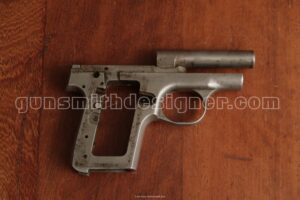
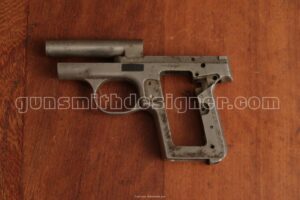
Frame Specifications:
-
- The frame (without the barrel) fits within a bounding box of: 120 mm x 73 mm x 16 mm (the height increases to 88.5 mm if the barrel is included).
- Material: Stainless steel
- Magazine well dimensions: 28 mm x 11.66 mm
- Number of parts: 12
The frame of a pistol, much like that of a revolver, is a master component that integrates the locations for major functions: housing for the trigger mechanism, housing for the sear mechanism, housing for the hammer, housing for the hammer spring, the magazine well, the barrel seat, and the slide guide rails. This requires extensive, critical machining on a single part that ultimately serves as a junction—or, to use a trendy word in the contemporary firearms world: a platform.
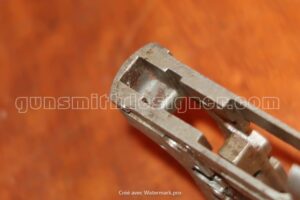
Some of these functions depend on one another. Each is a link in a chain where manufacturing tolerances affect the overall length of that chain. The gunsmith’s role is to harmonize the whole assembly.
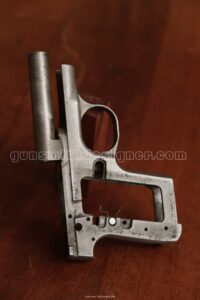
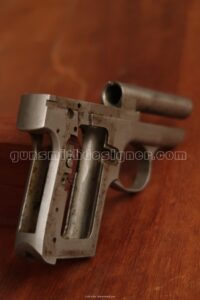
There is no firing pin safety; a grip safety (an investment-cast part) at the back of the grip restricts sear travel when the shooter’s hand does not fully depress the grip.
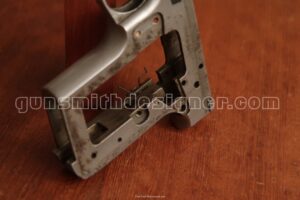
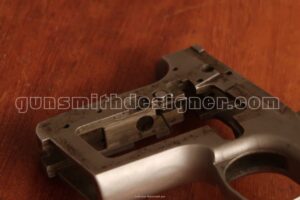
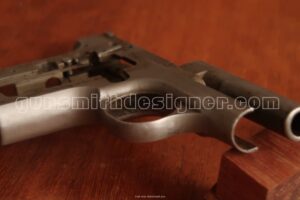
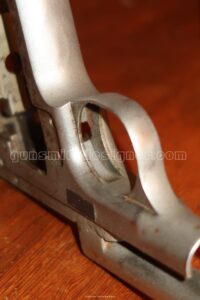
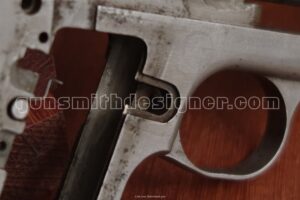
Machining a trigger housing often involves a complex set of operations. On the Backup II, this is not the case. Two simple machining operations… and it works.
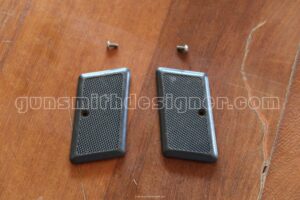
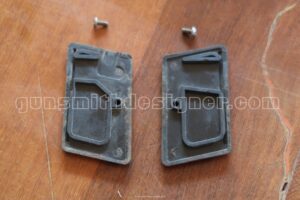
The grip panels are made of black plastic.
The Barrel
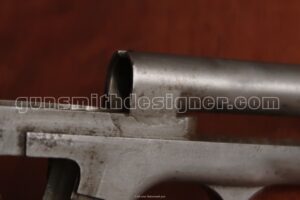
There are several ways to secure a barrel in place. Here, the barrel is welded to the frame. This is an unusual choice. A fixed barrel enhances accuracy. However, since we are examining a defensive firearm, accuracy is not its most demanded attribute. Therefore, the fixed barrel was likely chosen not for accuracy, but rather to simplify manufacturing. Machining marks are present around the weld, proving that an operation is performed after welding to reduce any potential excess thickness.
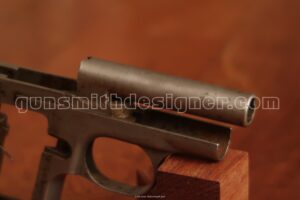
The barrel measures: 67 mm (including the chamber).
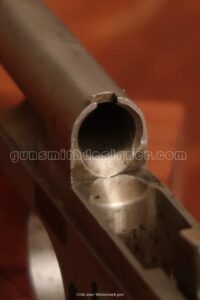
The barrel walls are thin. The outer diameter is: 12.8 mm. CIP standards dictate the following bore dimensions for this caliber:
-
- Land diameter: 8.84 mm
- Groove diameter: 9.04 mm
- Rifling twist rate: According to the manufacturer: 1 turn in 16 inches (406 mm); according to CIP standards: 1 turn in 250 mm.
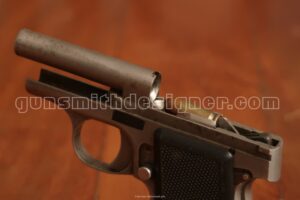
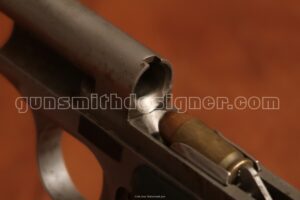
The internal diameter of the chamber is: 9.62 mm. This results in a wall thickness at the chamber of: 1.59 mm.
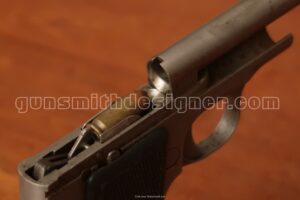
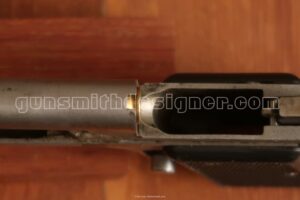
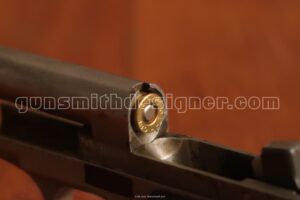
The extractor slot is located on the top centerline of the barrel.
The Trigger and Hammer Mechanism
The mechanism is quite simple, operating in single-action only. It consists of a trigger, a disconnector bar, a sear, and a hammer. The entire setup is driven by a few springs.
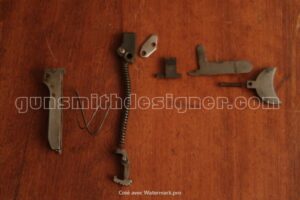
Two safeties exist on this firearm:
-
- A grip safety acting on the sear. If the operator does not fully depress the grip safety, the sear cannot rotate on its pin.
- A safety lever on the left side, which also blocks the movement of the sear.
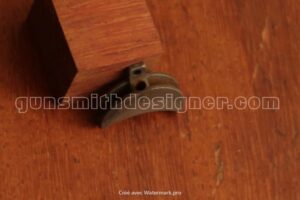
The trigger is produced via investment casting. The trigger spring sits in its center. A few spots of oxidation are visible.
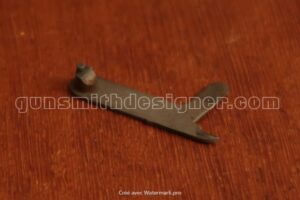
The disconnector bar consists of two parts. The thickness of this component is 1 mm. This part appears thin… but it works. A small cylinder is swaged onto it.
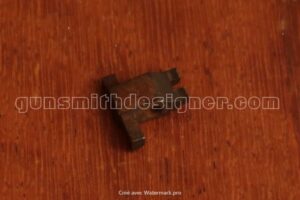
The sear is an investment-cast piece. It features an extension on each side: on the left to limit movement via the manual safety, and on the right for the rear grip safety and the disconnector bar. The sear of the firearm shown here is oxidized, as are several parts of the mechanism.
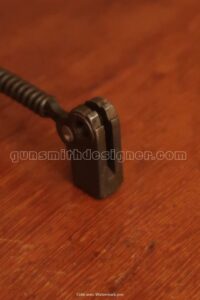
The hammer is an investment-cast component. It is slotted in its center to accommodate the ejector. Two notches are cut into its base (a half-cock notch and a full-cock notch).
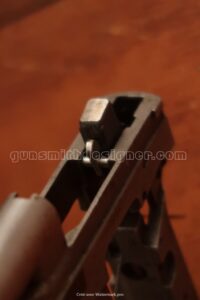
The ejector sits in the middle of the hammer. It is made of stamped sheet metal.
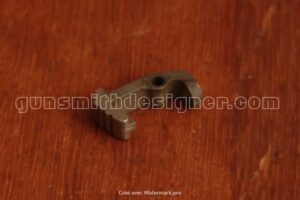
The magazine catch is a component with complex geometry. It would have been particularly time-consuming and expensive to produce by any method other than investment casting. The magazine catch is located at the base of the grip. The operator must shift their grip to extract the magazine. In an emergency scenario, there is less chance of accidentally losing the magazine than by pressing a push-button located near the thumb… a matter of personal preference.
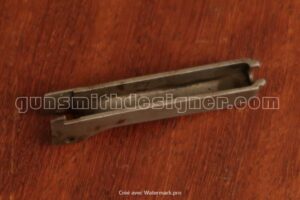
The grip safety is also an investment-cast part. Much like the disconnector bar, the walls of the grip safety are very thin. This demonstrates the precision of this process.
The Slide and Simplification via Division
The most significant aspect from a design perspective, which links this article to the previous one, is the slide. The slide alone followed the path of simplification via division. It is split into two parts, which I will refer to as the slide body and the breech block (see photos below).
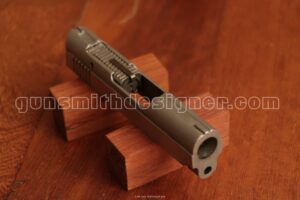
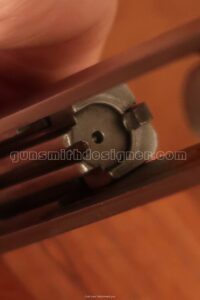
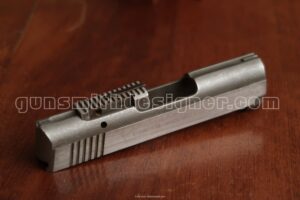
The slide fits within a bounding box of: 124.5 mm x 31.5 mm x 20.3 mm. It is made of steel. I believe the blank for this part is investment-cast. I say “I believe” because it is not glaringly obvious. What leads me to this conclusion is the shape of the hammer pocket. Since the hammer is enclosed, an internal pocket must be formed (similar to the Ruby pistol). On the Backup II, this pocket cannot be achieved through conventional machining (milling), as it lacks milling cutter marks (cutter radii; here, the corners are sharp). The investment casting is highly precise.
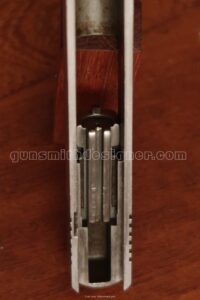
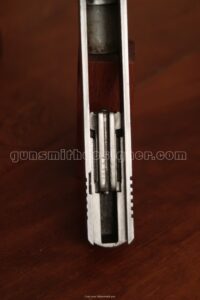
The recoil spring and its guide rod sit beneath the barrel.
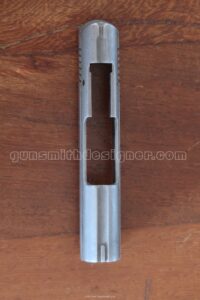
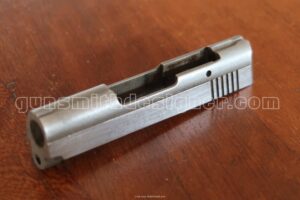
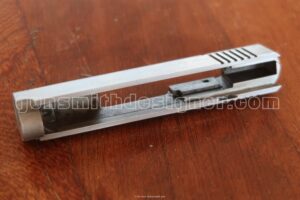
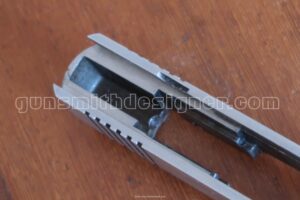
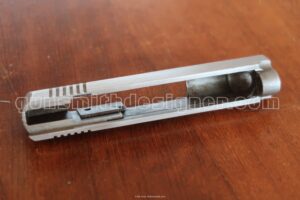
The slide is in two parts, which divides the manufacturing difficulty. This creates access where there previously was none, limiting potential scrap rates after complex machining operations. Choosing a removable breech block is also highly practical if the manufacturer produces the same firearm model in multiple calibers. If the slide body remains identical for different calibers, one only needs to change the “breech block” depending on the version. The Backup II pistol, however, only exists in .380 Auto.
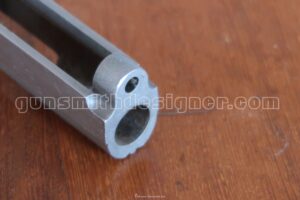
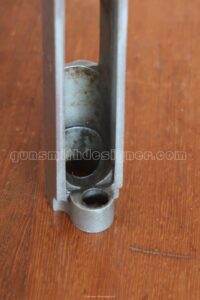
The breech block is removable. It fits within a bounding box of: 35.3 mm x 14.8 mm x 14 mm. It is secured to the slide body by a slotted spring pin (roll pin, diameter: 3 mm). The force generated by the combustion gases does not bear upon this pin. In other words, the secondary component is not merely held in place by a spring pin; the designer integrated bearing surfaces for the breech block against the slide body. Upon firing, the pressure applied through the cartridge case presses the breech block against its rear stops within the slide body.
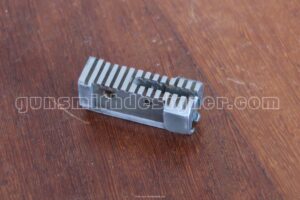
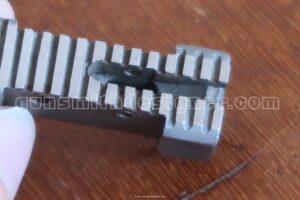
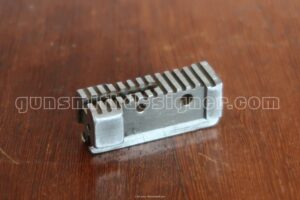
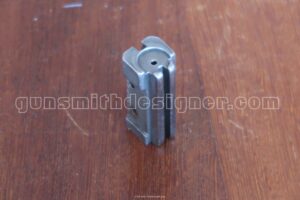
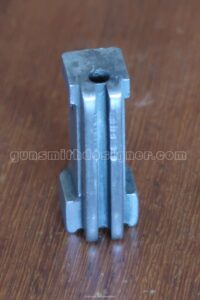
The breech block is disassembled from the top of the slide body after driving out the pin. Care must be taken to retract the firing pin into its housing using a fine screwdriver or by using the extractor (as explained further in this article); otherwise, you will not be able to separate the two components because the firing pin catches inside the slide body.
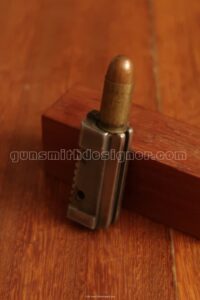
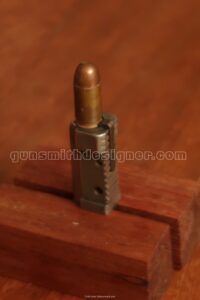
The slide does not feature a firing pin safety.
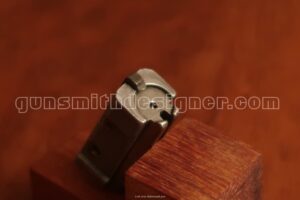
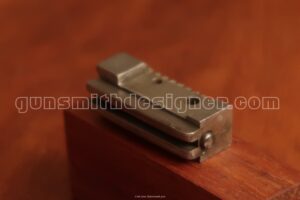
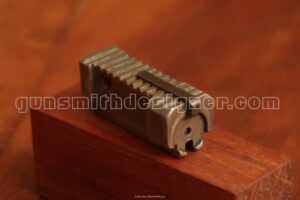
The weight of the complete slide is 178 grams. The weight of the slide body is 145 grams. The weight of the breech block is 32 grams. The weight of the assembly pin is 1 gram. These metrics are important for comparison purposes between firearms of the same category and caliber.
The slide is guided at the front by the barrel, and at the rear by two small lugs on the right and left sides of the frame. The barrel protrudes 1.8 mm from the slide. The slide travel is 34.35 mm (from its forward position to its rear stop).
Maximum cartridge length (according to CIP standards): 25 mm. Maximum case length: 17.33 mm.
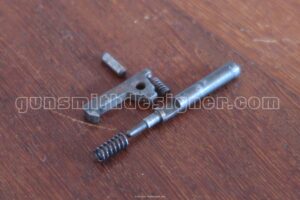
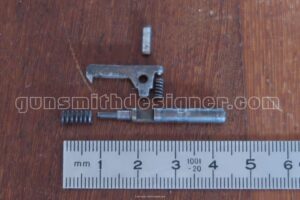
A projection on the underside of the extractor retains the firing pin in its housing. Ultimately, a single pin (the extractor pivot pin) provides cohesion to the assembly.
The extractor projection that retains the firing pin is useful when separating the breech block from the slide body. Indeed, the rear of the firing pin catches inside the slide during disassembly. However, lifting the extractor upward pushes the firing pin forward into its housing, preventing the rear of the firing pin from catching inside the slide.
The Magazine
Specifications:
-
- Magazine dimensions: 85 mm x 40.2 mm x 16 mm
- Magazine cross-section dimensions: 27 mm x 11.4 mm
- Magazine capacity: 5 cartridges
- Number of parts: 5
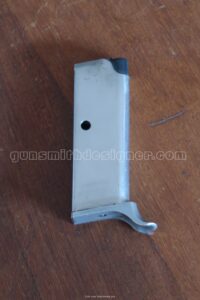
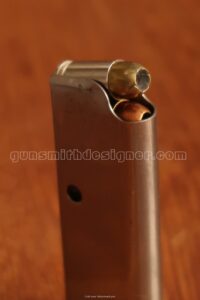
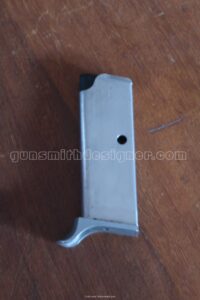
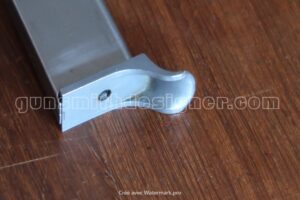
The magazine follower and the floorplate retainer are made of plastic. The magazine basepad is made of aluminum; it features a pronounced extension that is critical for gripping the firearm. Without it, the shooter would only have room for a finger and a half… or just one, depending on hand size.
Conclusion
If we compare the Backup II pistol and the Charter Arms revolver, these two firearms share clear similarities. But then… which one should you choose for self-defense? Is a revolver more practical? A pistol? Should one favor a single/double-action revolver mechanism, or a chambered pistol carried cocked and locked with a grip safety? Could one carry a loaded revolver with the hammer cocked under the pretext that the weapon features a firing pin safety? Are we certain that 5 rounds will suffice to handle the situation we might face? Conversely, which reloading method is more efficient? These questions are intended to prompt the reader’s reflection on the various choices available.
Revolvers, in my view, are much like pump-action shotguns. Although semi-automatic 12-gauge shotguns exist, pump-actions will likely never be dethroned; while one loses out on rate of fire and reload times, one gains in reliability and ruggedness. The revolver remains part of the spectrum of choices for both collectors and users.
The firearm examined here is in its original, uncleaned state. It was only minimally wiped down for the drafting of this article. It is supposed to be made of stainless steel, yet the photos reveal a light bloom of rust in some areas. It would have been easy to bead-blast the weapon to remove this surface rust (even in the smallest crevices) and restore a youthful appearance. This goes to show that a complete disassembly is useful from time to time; even if firearms are marketed as stainless steel, certain grades of these steels can still oxidize. A deep, periodic inspection also prevents unpleasant surprises after buying or acquiring a used firearm.
When so many components of a single firearm are manufactured through investment casting, the time savings must be substantial. However, the parts still need to be properly finished. Two schools of thought could compete here. The first limits post-casting operations to the strict minimum (accepting surface imperfections and a somewhat raw finish). The second produces casting blanks with enough material to re-machine all surfaces, resulting in an aesthetically flawless component with tighter tolerances. In the latter case, the cost savings offered by investment casting are not fully realized.
The reputation of AMT firearms has not always been stellar: manufacturing flaws, design flaws, finishing issues, and feeding problems. According to several internet sources, this was the reason for the sale of the company. What is a company worth if its products are mediocre? Why buy a company if its outputs are unstable and suffer from a poor reputation? This is an intriguing question whose underlying business realities would be valuable to understand for gunsmiths tempted to invest in or establish a brand.