


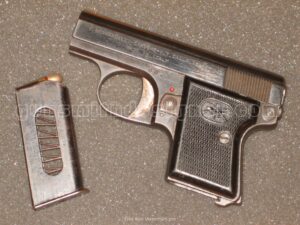
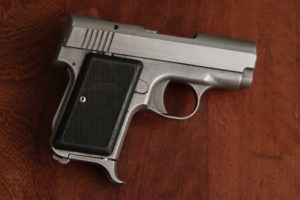
Today, I have the opportunity to write about the V. Bernardelli Model 68, also known as the “Baby.” The firearm I am presenting to you is chambered in 6.35mm or .25 ACP.
I wanted to talk about this handgun because I did not expect to find such a beautiful finish on an arm of this type—namely, a small pocket defense pistol. The second reason for writing this article is how the barrel mounts to the frame. It is quite unusual, extremely well executed, and well worth taking a closer look at.
Bernardelli Baby Specifications
I will not go over the history of this handgun, as I do not have much data on the matter. It seems that the first models appeared in the 1940s/1950s. You can find the history of the V. Bernardelli company by clicking on the brand’s logo.

A version of this firearm exists in .22 Short. It would have been useful to compare both models to highlight their common points and differences. However, I was unable to gather both versions at the same time. Therefore, I cannot make that comparison today. Hopefully, the future will grant me the opportunity to conduct this experiment later on.
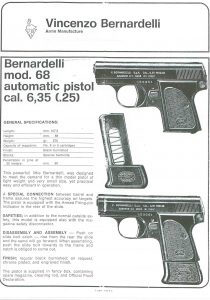
- Overall Length : 106.5 mm ;
- Overall height of the weapon : 69 mm (with the 5-rounds magazine), 68.5 mm (without magazine) ;
- Width : 20.5 mm ;
- Weight : 260 grams (with an empty 5 rounds magazine) ;
- Barrel length : 53 mm ;
- Caliber : 6, 35 mm Browning or 25 acp ;
- Capacity : 5 to 8 depending on the magazine (a 5 round magazine is featured here) ;
- Mechanism type : single action ;
- Safety lever : Located on the left side of the frame ;
- Magazine safety : yes ;
- Grip : good handling, despite the small volume of the firearm ;
- Material : entirely made of steel (except the grip panels) ;
- Number of parts : 39.
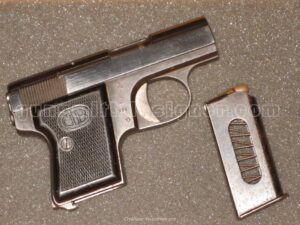
Field Stripping the Bernardelli Baby :
Field stripping this firearm does not require any special tools. The various steps to complete this task are detailed below :
- Handling any firearm can cause serious damage. Consequently: always point the firearm in a safe direction away from yourself or others, ensure the weapon is unloaded (no magazine engaged), and check that the chamber is empty ;
- Remove the magazine from the firearm ;
- Verify that the chamber is empty ;
-
While checking the chamber, you will likely cock the striker (depending on how far back you pull the slide). It takes a 23mm rearward slide stroke to cock the striker. You can tell the striker is cocked when a small pointed piece protrudes from the back of the slide ;
-
- Press the button located on the rear of the frame, on the left side of the firearm ;
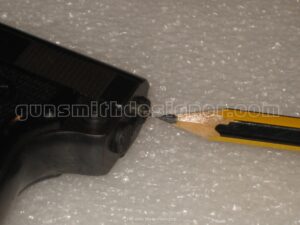
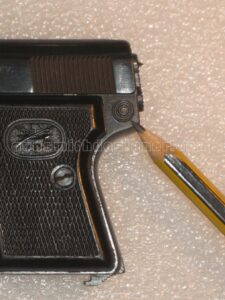
- Regardless of the striker’s position (cocked or uncocked), the assembly lever will pop out of its housing under the pressure of the striker spring and the sear spring ;
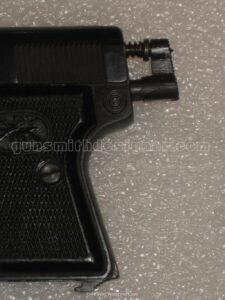
-
Push the striker spring back inside the slide. To do this, if the striker was cocked during previous manipulations, you must engage an empty magazine (just enough to disengage the magazine safety from the trigger bar, see the next photo) and pull the trigger (hence the importance of having checked that the chamber is empty);
-
- Remove the magazine again ;
- Pull the slide back a few millimeters to disengage the extractor from its slot ;
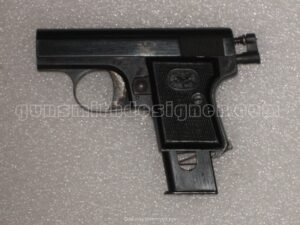
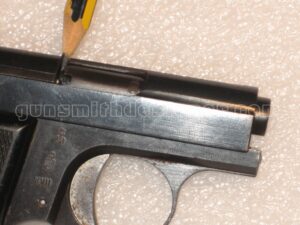
- Once the extractor is disengaged, lift the rear of the slide ;
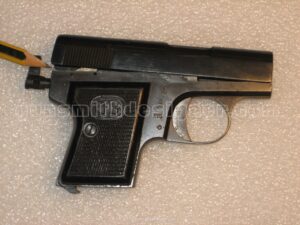
- When lifting the rear of the slide, be careful not to lose the disconnector. It is prone to slipping out. We will look at the role of this part later on ;
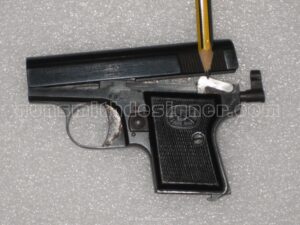
- Under the action of the recoil spring, the slide will slide off its housing toward the front. Guide the slide through this movement. Be careful not to lose the disconnector, the striker spring, the striker, the recoil spring, and its guide rod ;
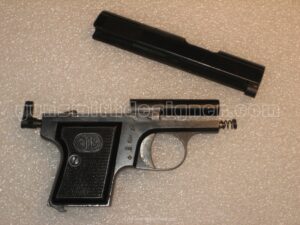
- To remove the barrel, extract it by pushing it to the left (on my specific model, it comes out through the left side) ;
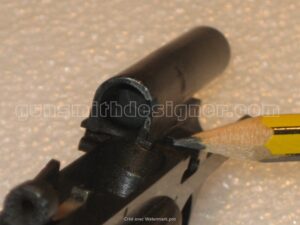
- Field stripping is now complete; you are left with the following components ;
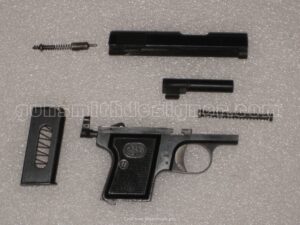
The Bernardelli Baby Sub-assemblies
The sub-assemblies of the 6.35mm Bernardelli Baby pistol are :
- The slide / barrel sub-assembly ;
- The frame sub-assembly ;
- The magazine sub-assembly.
The Slide / Barrel Sub-assembly
The slide/barrel sub-assembly of the studied weapon consists of 11 pieces:
- The slide ;
- The extractor ;
- The extractor spring ;
- The extractor pin ;
- The barrel ;
- The recoil spring ;
- The guide rod ;
- The striker ;
- The striker spring ;
- The striker spring guide/cocking indicator ;
- The cocking indicator return spring.
The slide is made of steel. Its dimensions fit within a volume of: 15.4 mm (width) x 21.5 mm (height) x 104 mm (length).
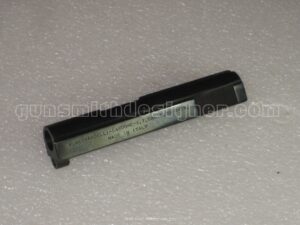
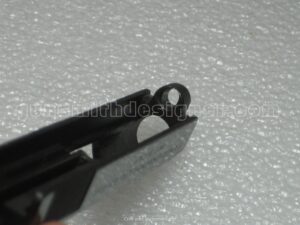
The weight of the part (with the extractor) is 72 grams. The distance between the underside of the slide (or top of the frame) and the barrel axis is 4.5 mm.
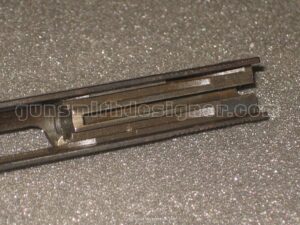
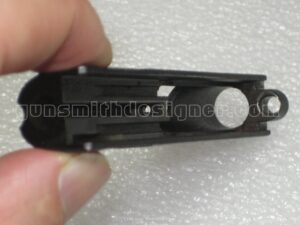
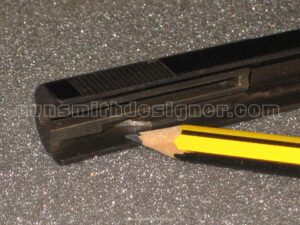
The breech face diameter (where the cartridge casing base sits in the slide) is 8 mm with a depth of 0.94 mm.
The maximum travel of the barrel inside the slide (the same with or without the recoil spring) is 28 mm, while a live round measures approximately 22.8 mm.
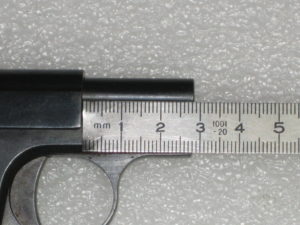
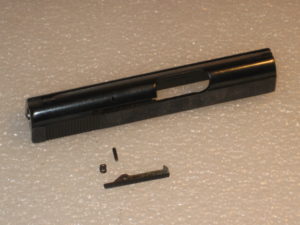
Advanced disassembly of the slide components involves driving the extractor pin out of its hole using a 1.5mm pin punch. The pin is thin and short. The extractor spring measures 3 mm in length with a diameter slightly under 3 mm. These parts are very small: be careful not to lose them. Stripping these parts gives you proper access to clean the extractor slot. This area is rarely accessible, making it the perfect opportunity to do a thorough job. Clean the parts before reassembly as well.
The striker body diameter is 5.96 mm. The striker tip diameter is 2 mm. The overall length of the striker is 19.5 mm. It would be interesting to compare the striker of this 6.35mm version with that of the .22 Short version. Indeed, firing a rimfire cartridge like the .22 Short requires striking the rim of the casing. In this case, two layout options seem possible:
- Either increase the striker body diameter to 7 mm (the rim diameter of a .22 Short rimfire round) and then offset the striker tip to the periphery of the 7mm cylinder ;
- Or offset the striker channel itself ;
- Or apply both solutions simultaneously.
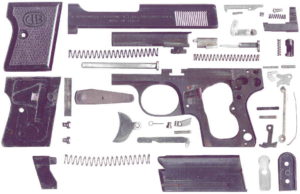
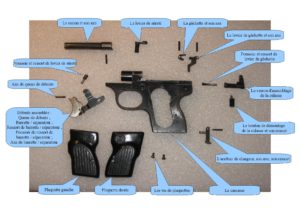
Which option did the manufacturer choose? To this day, I do not have the exact answer because I do not have access to the dimensions of the .22 Short part. However, a schematic of the .22 Short version helps our analysis. On the exploded view below, we can see the shape of the striker, but also that ejection is not operated by the striker itself, but rather by an extension of the striker spring guide rod.
The slide does not move along the frame via machined rails like on most automatic pistols. The slide is guided at two specific points :
- The first guide point is the barrel, as the front of the slide cycles around it ;
-
The second is the assembly lever. By entering the striker channel, it restricts the slide’s path.
After firing, the slide requires a rearward travel of 23 mm for the striker to cock again. The striker’s cocking lug does not protrude from the bottom of the slide. It is the sear that catches it as it cycles. The striker also functions as the ejector. At the end of the slide’s rearward travel, the tip of the striker protrudes by 3.6 mm through the breech face, giving an impulse to the empty casing, which pivots around the extractor and ejects.
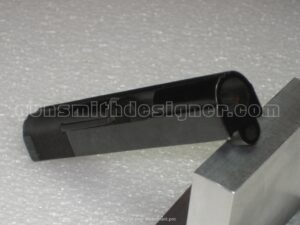
The barrel fits within a volume of: 53 mm (length) x 11.7 mm (width) x 14.4 mm (height). The outer diameter of the round section is 9.8 mm. The weight of the barrel is 21 grams. The rim of the cartridge remains outside the chamber.
Was the barrel rifled after its profile was machined? Or did the rifling happen first, followed by the profile machining? This would be interesting to know. I would lean toward the second option (as it is the most common). Namely: using steel bars several tens of centimeters long, drilled and rifled to the 6.35mm caliber. The bars are then cut to the desired length. The barrel’s outer profile is obtained by machining these cut portions. Finally, the chamber is cut using a specific chamber reamer. The Bernardelli Baby barrel can be manufactured from a rifled blank of 14 mm minimum diameter. The barrel features 6 left-hand grooves.
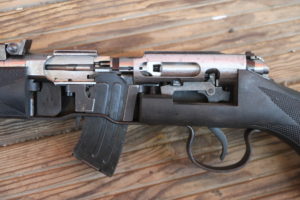
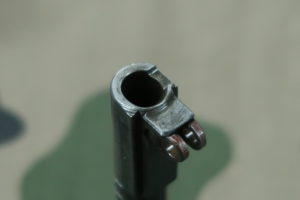
One of the significant design choices on this handgun is the mounting method chosen by V. Bernardelli to lock the barrel to the frame. This type of mounting is rarely utilized. The barrel is secured to the frame via an inverted T-shaped interlocking fit. The barrel slides laterally into a matching groove machined into the frame. The machining does not feature simple rectangular shapes (which one might expect) but rounded curves. While machining the female housing requires a specific form cutter, the male lug requires more complex machining and fitting. I believe this choice reflects the manufacturer’s desire to prevent stress cracks from developing in the corners (particularly the upper corners) which a sharp rectangular shape would be prone to. The fit on my specific handgun is exceptionally well crafted; once seated on the frame, the barrel exhibits almost no play.
The width of the T-lug base is 11 mm. The height of the T-lug base is 2 mm.
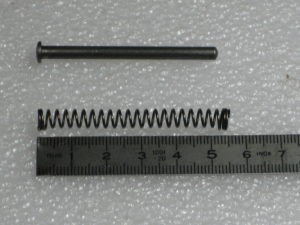
The recoil spring has a length of 55 mm. The wire diameter is 0.7 mm. The spring flares out at both ends. At its center, the outer diameter is 5.7 mm. The flared ends have an outer diameter of 6.6 mm.
The guide rod has a length of 53.6 mm with a body diameter of 4 mm.





The slide on mine does not go back far enough to cock the pistol. what may be wrong? How do I fix this.
Bonjour,
It s not easy to answer without see the gun in hands.
May be the munition is too slow.
Your faitfully.
Cédric.
I had exactly the same question about my pistol. The slide didn’t seem to go back far enough to allow the striker catch to engage with the sear. But this was a misunderstanding. The real problem was that the separator (more commonly called the disconnector) was missing. As the instructions above warn us, this part is very easy to lose. This caused the trigger to always be disconnected from the striker. Once I found it and reinstalled it, the pistol worked normally.
Richard, I lost my disconnector to my pistol. Do you have any idea where I could get another one? Not having much luck with venders online. Any help would be grateful!! My email: jp0772@aol.com Thanks!!
Hello,
No, i dont know where yuo can find this part.
Your faithfully.
Cédric.
I had exactly the same question about my pistol. The slide didn’t seem to go back far enough to allow the striker catch to engage with the sear. But this was a misunderstanding. The real problem was that the separator (commonly called the disconnector) was missing. As the instructions above warn us, this part is easy to lose! This caused the trigger to always be disconnected from the striker. Once I found it and reinstalled it, the pistol worked normally.
Per favore mi interessano dei ricambi per calibro 6.35 bernadelli modello 68 mi servirebbe il precursore completo della molla è tutto il kit che va con il precursore e la molla di ritorno
how do I get age of my gun, serial # 13686 and what would be the value this is a 22 L/ short magazine, whon would be able to clean the gun I live in New Hampshire
Hello,
I dont have the list of numbers / year.
Your faithfully.
Cédric.
Hello
My Bernadelli VP 25 was missing the disconnector when I purchased the gun and I was trying to locate a replacement part. I noticed Numrich gun parts sell them but they seem to be out. Would anyone happen to know who would have them in stock?
Hello,
Now, i dont know where you could find the parts.
Your faithfully.
Cédric.