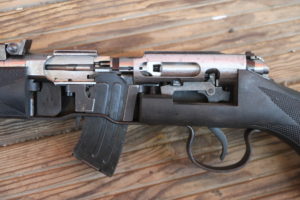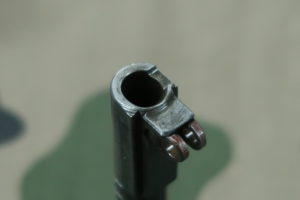


A significant quantity of Kalashnikovs has been manufactured worldwide. Production quality varies widely depending on the country and the manufacturer, ranging from large state-owned factories and engineers producing hundreds of thousands of weapons to anecdotal, one-off builds.

The vast number of weapons a state must manufacture to equip its units requires a standardized production tool to ensure batch uniformity and parts interchangeability. Conversely, small-scale production does not necessarily require this standardization because parts are not meant to be quickly interchangeable; they can be fitted more or less manually.
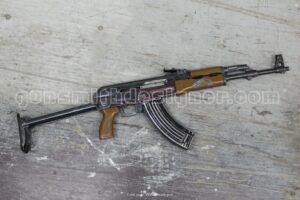
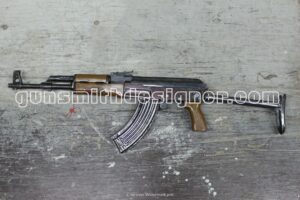
A twist of fate allowed me to hold a weapon destined for a French museum. The first question that came to my mind upon discovering it was: who built this weapon?
Today, I present to you this weapon that caught my attention at the time.
A Kalashnikov from the Khyber Pass?
For readers unfamiliar with this place, videos can be found online showing very diverse production means, but they are far from state standards :
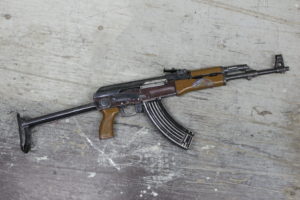
The weapon I am talking about here comes from Afghanistan. I do not know under what circumstances it was sent to a French museum, nor how it ended up in Afghanistan in the first place. However, I wanted to talk to you about this Kalashnikov because the finish quality does not meet the standards of large state factories. Although photos do not truly capture the defects, the sub-assemblies that call for the most commentary will be detailed below. I find that two parts are particularly poorly machined: the receiver and the bolt carrier.
The bolt carrier
The moving assembly of a Kalashnikov consists of the bolt and the bolt carrier with its gas piston. Both parts are interesting to observe because there is a distinct difference in finish quality between the bolt and its carrier. Indeed, while the carrier is not very nice, the bolt seems to have a decent finish.
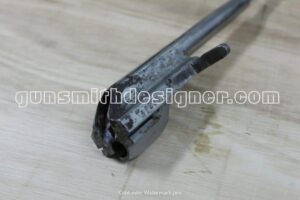
While the visible parts of the bolt carrier look presentable, the same cannot be said for the internal parts, which are not visible from the outside.
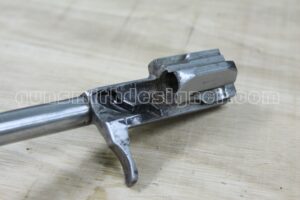
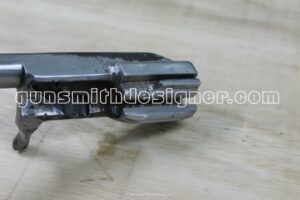
What can be observed on these components?
The most critical portions for the reliable operation of a firearm are the hidden parts. Indeed, the relationships between the various mechanical functions depend entirely on them.
Here, the internal parts were neglected; the greatest effort was put into the exterior. One could deduce that the manufacturer’s priority was appearance rather than reliability.
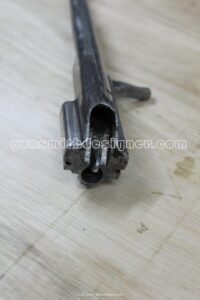
If we look at the rear of the bolt carrier, we can see that it has been damaged by successive strikes from the hammer. We will see the condition of the hammer in the next section. The material is visibly unsuitable.
The bolt
Traces of chisel use are visible on the bolt. Nowadays, it is rare to use this type of tool for mass production. It requires at least a second finishing step to reduce the marks left by the chisel and to obtain more uniform, flatter surfaces. This is not the case here; the worker(s) stopped at the first step.
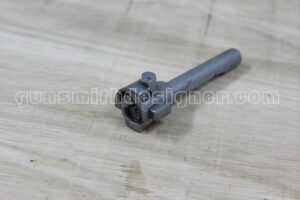
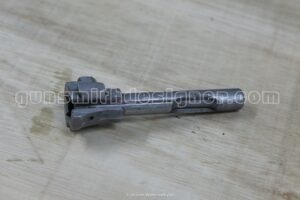
The bolt tail housing was also neglected; it remains rough from drilling. What would it have cost the manufacturer to drill a smaller hole and use a reamer? It was not done. The bolt has significant play inside its housing. You might say that for a Kalashnikov, this is not surprising. Which is both true and untrue, because although there is play in Eastern European counterparts, this play is much less significant, and the parts are perfectly made.
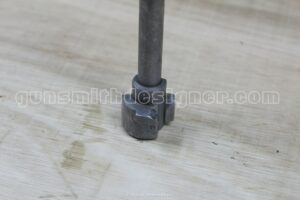
The bolt bears no serial number. It is possible that it is not original. As stated above, it is better finished than its carrier. Perhaps it comes from a subcontractor who only manufactures bolts and therefore masters their production better. That could be a hypothesis.
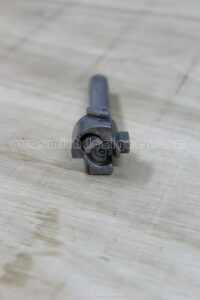
The irregularities in the bolt tail housing did not damage the bolt. The locking surface shows no signs of use or firing. Unlike the rear of its carrier, the rear of the bolt was not damaged by the hammer.
The receiver
Depending on the Kalashnikov version, two types of receivers are possible:
- Either a milled receiver, meaning it is obtained by milling, drilling… (hence by material removal) from a solid steel billet;
- Or a stamped receiver, obtained by bending a 1 mm sheet of metal onto which the barrel trunnion (at the front end), the stock trunnion (at the rear end), the ejector rail (spot-welded inside on the left side), and the rail opposite the ejector (spot-welded inside on the right side) will be riveted.
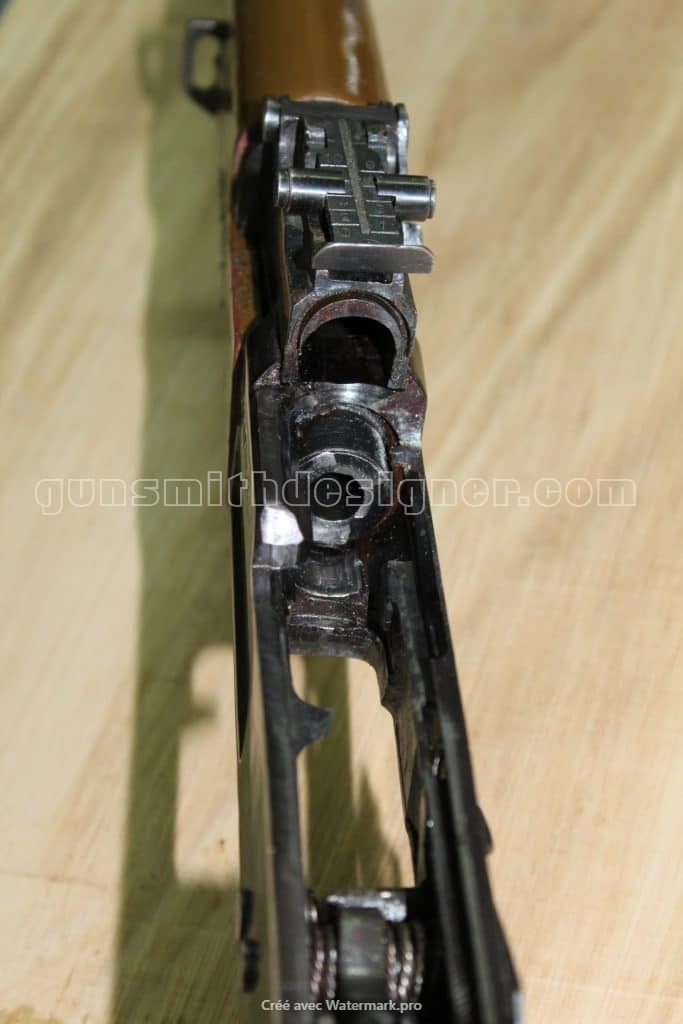
The receiver we have here is a milled version. The defects visible to the naked eye do not translate perfectly in photos.
The vast majority of the parts were finished with a file and then blued. There is no intermediate finishing step, and visibly, these were not fine files.
The condition of the hammer shows it is mushroomed from repeatedly striking the bolt carrier. This is not what one expects from a military weapon. Especially given how dangerous the Afghan theater is.
Machining marks under the ejector lead me to believe that the tip of the ejector was welded onto the receiver.
The surface condition of the chamber is not smooth; concentric circles can be seen, probably left by the chamber reamer.
The slightly reddish color of the receiver may indicate a good carbon content in the steel.
The markings
The markings found on this weapon suggest it is a Chinese weapon, a Type 56 AK 47. Is this true? I am not an expert on Kalashnikovs in general, nor on the Chinese version in particular. The « 56 » in the weapon’s inscriptions seems to have been restamped over older numbers.
If you have photos of Type 56 markings, please feel free to send them to me for comparison.
Conclusion
It does not seem to me that this assault rifle is of Chinese manufacture. I find it hard to believe that a large country like China would be unable to produce a military weapon with a proper finish.
For some parts, the quality of the steel seems very poor. One only has to look at the deformations in the metal to realize that it is malleable and unsuited to the stresses it undergoes.
The successive machining operations, which are poorly coordinated, show poorly mastered production means and procedures. As mentioned in the introduction, having interchangeable parts, which is required for large mass productions, demands very tight tolerances. To achieve them, you need rigid machines and tooling accompanied by strict procedures, which results in very clean surface finishes and parts within tolerances, ready to be assembled with little manual intervention.
The finishes on Kalashnikovs from Eastern European countries are very well done compared to the version we studied. The popular image that equates Kalashnikov with agricultural mechanics is inaccurate. The steels and their heat treatments are of good quality.
I have not fired this weapon and therefore cannot clearly demonstrate the direct or indirect impact of the finishes on shooting quality.
A weapon for what purpose? A poorly machined and poorly finished weapon, where the interior and its fire control components are sub-par, is a weapon that is not built to last. It seems to have been made more to be sold than to be used. This cannot give satisfaction in the long run. It is better to focus on quality rather than wasting time with overly crude manufacturing.
If you own an authentic Type 56 Kalashnikov, please feel free to send me photos; they will allow me to compare the specimens.
 Je ne détaillerais pas ici toutes les pièces du Manurhin PP Sport car le présent article fait écho à un autre :